If you want to learn how to measure ring size with string, you are using one of the most common at-home sizing methods. It is simple, cheap, and easy to repeat with everyday items. You do not need a special kit to get started, but you do need to measure carefully because a few millimeters can change the result.
Paper usually gives a cleaner reading than string, but both methods can work when you follow the same slow process each time. Measure the base of the finger, keep the wrap snug without pulling hard, and convert the final length with a reliable tool instead of guessing.
What You Need
For the paper method, use a thin strip of paper, a pen, and a ruler that shows millimeters. For the string method, use a non-stretch string if possible. Thick yarn, elastic cord, or fluffy thread can distort the measurement because they add bulk or stretch under tension.
Have good light and a flat surface before you start. Ring sizing is easier when you can mark the overlap cleanly and read the ruler without rushing. If your first measurement feels awkward, do not force it. Cut a second strip and start again.
- Thin strip of paper or thin non-stretch string
- Pen or fine marker
- Ruler with millimeter markings
- Optional phone with our ring size calculator for conversion and cross-checking
Step by Step - Paper Method
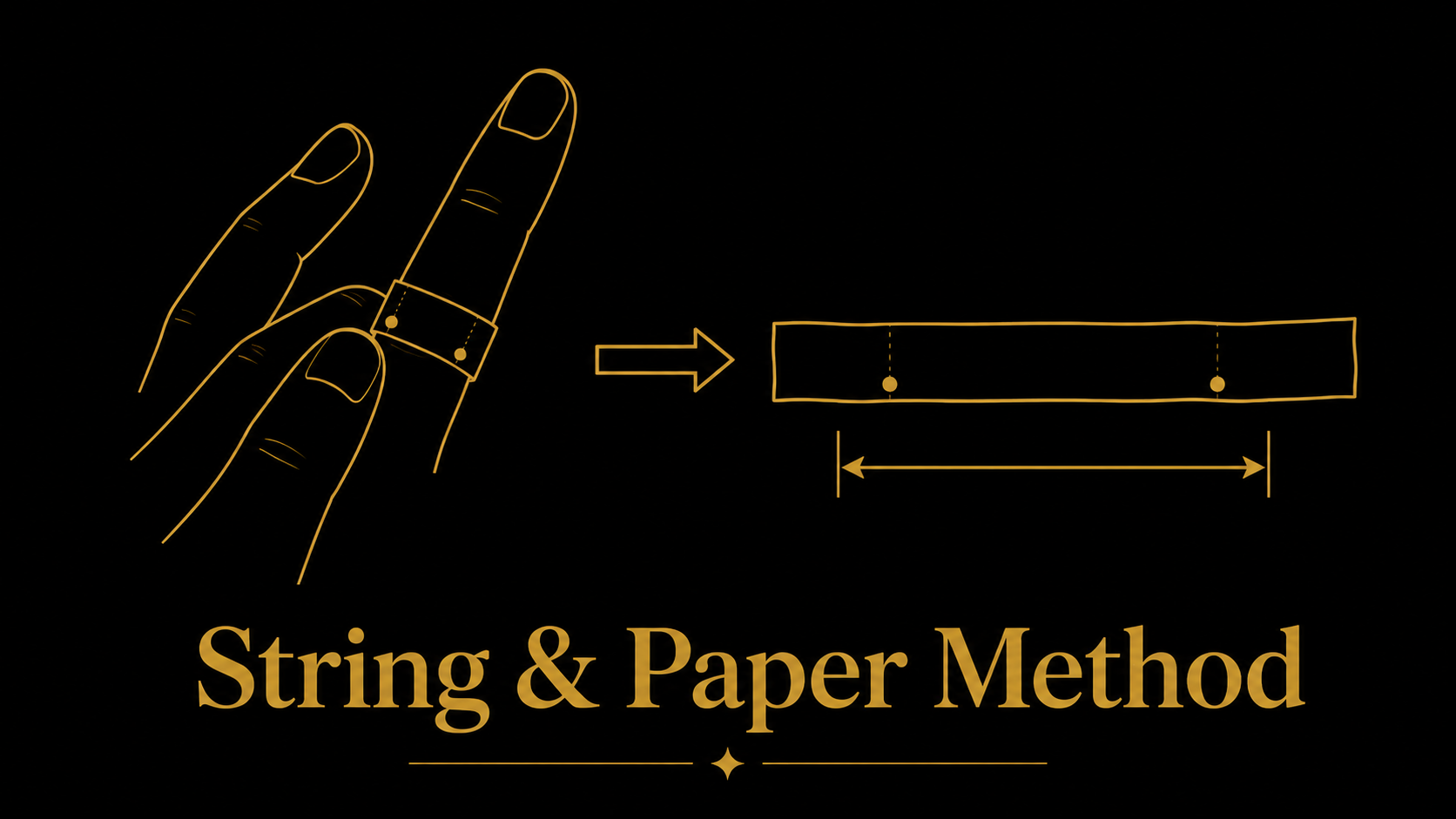
Paper is usually the better home method because it holds its shape and does not stretch while you wrap it. Cut a narrow strip, wrap it around the base of the finger, and mark the point where the ends overlap. That length is your finger circumference.
Once you have the length in millimeters, enter it into our ring size calculator. The tool converts the measurement into the closest ring size and helps you compare across country systems if the store you are shopping from does not use your local standard.
- Cut a strip that is narrow enough to sit flat against the skin.
- Wrap it around the widest part that still has to slide over the knuckle if needed.
- Mark the exact overlap point, not a gap before or after it.
- Lay the strip flat and measure the marked length in millimeters.
Step by Step - String Method
The string method follows the same logic as the paper method, but it needs a little more care because soft material can stretch. Use the thinnest non-stretch string you can find and avoid pulling it tight just because it feels flexible. The goal is to copy how a ring would sit, not how hard a string can be pulled.
After marking the overlap, lay the string flat along a ruler and measure it in millimeters. If the number changes each time you repeat the test, trust the paper result instead. String is helpful in a pinch, but paper usually wins when the two methods disagree.
- Use non-stretch string if possible.
- Keep the wrap level instead of letting it tilt upward or downward.
- Mark the overlap with a tiny dot so the reading stays precise.
- Repeat the method at least twice because string results can drift more than paper.
How to Convert the Measurement
If you only have circumference, you can convert it by formula. Divide circumference by 3.14159 to estimate the inner diameter. That gives you a diameter value you can compare with common ring charts. The math works, but many people still prefer a direct converter because tables and country systems can be confusing.
The easier route is to enter the circumference directly into our ring size calculator. That removes manual conversion errors and lets you check US, UK, EU, and India sizes at the same time.
- Circumference is the full length around the finger.
- Diameter is the width across the inside of a ring.
- Formula: diameter = circumference / 3.14159
- Always round carefully because even a small change can shift the suggested size.
Common Mistakes to Avoid
Most sizing mistakes do not come from the method itself. They come from small habits like pulling too tight, measuring cold fingers, or reading the wrong line on the ruler. These errors are easy to miss because the difference feels tiny, but ring sizing is a small-number game.
If the result feels uncertain, stop and repeat later in the day. One calm second try is usually more useful than forcing a guess from a messy first measurement.
- Using stretchy string that lengthens under tension
- Measuring the wrong finger or the wrong hand
- Taking a reading when fingers are very cold
- Marking a loose wrap because it feels more comfortable than a real ring fit
- Forgetting that wide bands often need slightly more room
Use Our Free Ring Size Calculator
Once you have your paper or string measurement, plug it into our ring size calculator to convert it quickly and compare standards. It saves time, reduces chart-reading mistakes, and helps you confirm whether your home measurement looks realistic.
If you want a second method for comparison, read how to measure ring size at home. Checking both guides can help you spot an error before you order a ring.
FAQ
Is the paper method accurate for ring sizing?
Yes, paper can be fairly accurate when the strip is thin, the wrap is snug but not tight, and you measure in millimeters. It is usually more reliable than stretchy string.
What is the formula for converting circumference to diameter?
Divide the circumference by 3.14159. That gives you an estimated inner diameter, which you can compare against ring size charts or enter into a conversion tool.
Should I measure in millimeters or centimeters?
Millimeters are better because ring size changes happen in very small increments. Centimeters are easier to misread or round too loosely for a precise fit.
What if I am between two ring sizes?
If your reading falls between two sizes, choose the larger size in most cases. That is especially helpful if the ring is wide or if your fingers tend to swell later in the day.