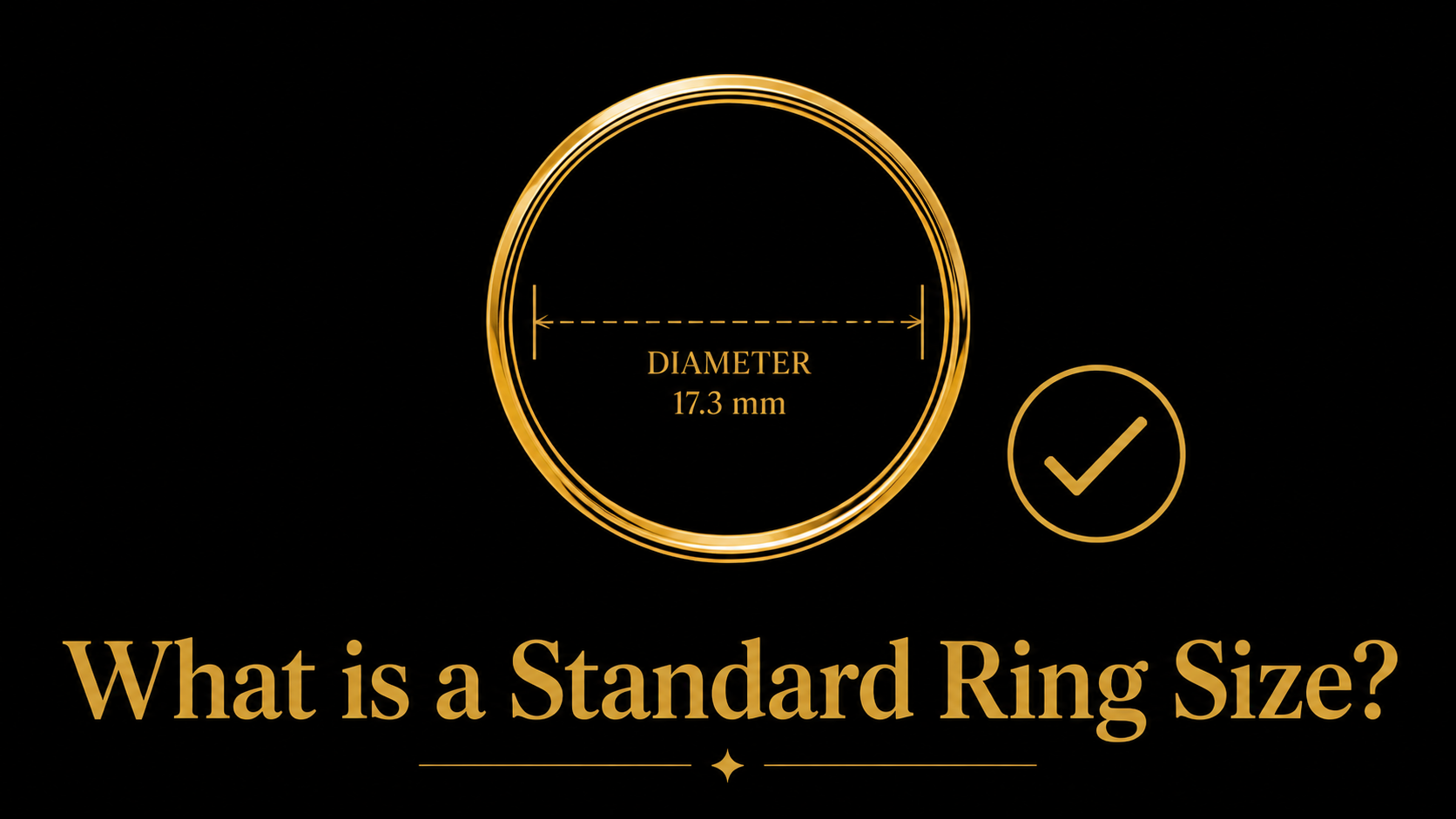
What is a standard ring size? The short answer is that there is no single universal standard ring size for every person or every country. Most people use the phrase to mean the size stores most often stock first, not an official technical rule that fits everyone. In practice, that usually means US 6 to 7 for many women and US 10 for many men.
That makes standard size a useful shopping shortcut, but a poor substitute for a real measurement. It helps you understand what is common. It does not tell you what will actually fit your finger or someone else's ring comfortably.
What "Standard Ring Size" Usually Means
In everyday shopping, standard ring size usually means the most commonly sold starting size. For women, many stores treat US 7 as the standard stocked size. For men, many stores treat US 10 as the standard stocked size. That makes manufacturing and inventory easier because stores can build around the sizes most buyers request first.
This is a business convenience, not a universal fit standard. A standard size is just the center point a seller expects to resize from if needed. It does not mean most people will fit it perfectly without adjustment.
Standard Ring Sizes by Country
Each country tends to think about standard sizes through its own chart. In the US, women are often centered near 6 to 7 and men near 10. In the UK, common stock ranges often land near L to M for women and T for men. In the EU, many sellers think in circumference values like 52 to 54 for women and around 62 for men. In India, the same middle zone is often described around 12 to 13 for women and 20 for men.
Those numbers look different, but the idea is the same in each market. Stores keep what sells most often, then resize up or down around that middle point. The label changes by country, but the retail logic stays similar. For the specific numbers most common in the US and UK, see average ring size for women and average ring size for men.
Why Jewelry Stores Use Standard Sizes
Stores use standard sizes because it is cheaper and faster to manufacture popular middle sizes first. A ring made near the common range can often be adjusted one or two sizes more easily than a ring that starts at an extreme size. That keeps inventory manageable and shortens delivery time for many customers.
From the store side, this makes perfect sense. From the customer side, it is easy to misread. Standard does not mean ideal. It just means common enough to stock in advance.
Standard Ring Size vs Your Actual Size
Your actual size depends on your finger, your hand, the ring width, and even the time of day. A standard size might happen to fit you, but there is no reason to assume it will. This is why default stock sizes are good for inventory planning and weak for personal sizing accuracy.
The best way to use a standard size is as a fallback when you have no other information. The best way to buy a ring is still to measure the finger or compare an existing ring first. For a side-by-side comparison of typical men's and women's ranges, see the ring size chart for men vs women.
How to Find Your Actual Ring Size at Home
You can measure your actual size at home with a calibrated phone screen, a strip of paper, or a ring that already fits. The key is to use a real measurement instead of assuming a standard number will work. That is especially important if the ring is wide or if your fingers swell during the day.
For the full method, read how to measure ring size at home. That guide walks through the practical steps instead of stopping at a generic average.
What Size to Order If You Want a Standard Fit
If you need one fallback number, US 7 is often the safest standard-style default for women and US 10 for men. Those sizes sit near the most commonly stocked center points and are often easier to resize than an uncommon extreme. They are still defaults, not guarantees.
Use them only when you cannot measure first. If you can get any direct clue from a current ring or a finger measurement, that clue is almost always better than ordering from a standard stock assumption. For more guidance when you are genuinely unsure, read best ring size to order when unsure.
Use Our Free Ring Size Calculator
Our ring size calculator helps you move beyond the vague idea of a standard size and check an actual ring or measurement instead. That is the fastest way to see whether a standard default like US 7 or US 10 matches reality.
If you want the practical home steps, compare this guide with how to measure ring size at home. If you are also dealing with size changes over time, the next useful read is does ring size change with age or weight.
FAQ
What is a standard ring size for a woman?
Many stores treat US 7 as a standard stock size for women, though US 6 and 7 are both common starting points depending on the seller.
What is a standard ring size for a man?
Many stores treat US 10 as the standard stock size for men because it sits near the common middle range.
What does ring size 7 mean?
Ring size 7 is just one measurement point on the sizing scale. In the US system it refers to a specific inside diameter and circumference, not to a universal fit level.
Is there a universal ring size?
No. There is no one universal ring size that fits everyone, and there is no single country system used everywhere in the same way.
Does 0.25 ring size make a difference?
It can, depending on the person. A quarter-size (0.25) difference is approximately 0.4mm in inner diameter. For people with sensitive fit preferences or slim fingers, that small gap is noticeable. For most everyday wear, a quarter size is a minor adjustment that many people would not feel strongly. Where it matters most is with wider bands, since more metal contact makes even small variations more apparent. When ordering, if you fall between two sizes, rounding up by a quarter size is usually the safer choice for comfort.